
Design-Build Timeline: What to Expect When You're Not On-Site


Building a home from another city or another country can feel complicated. But you don't need to be physically present every day to build a home well.
With the right design-build team, your role is not to supervise workers, chase suppliers, or visit the site every weekend. Your role is to make the important decisions, review progress at the right milestones, and trust your team to manage the work in between.
For many Filipino families, especially OFWs, business owners, executives, and professionals with demanding schedules, this is what a well-managed home construction journey should look like.
The important part is this:
You don't have to be on-site every day. You need a clear process, a responsible team to handle this project with expertise, and a reliable way to stay informed.
How Long Does a Design-Build Home Take?
For a typical custom home in the Philippines, a realistic overall timeline can look like this:
These phases can overlap. The actual timeline depends on the project's size, complexity, location, permit process, weather, material lead times, and how quickly decisions are made.
What Changes When You're Not On-Site?
Not being physically present doesn't mean being uninvolved.
It simply changes how you participate.
Instead of spending your time:
- Checking if workers arrived
- Inspecting deliveries
- Following up with suppliers
- Coordinating subcontractors
- Asking for daily updates
- Visiting the site to check progress
- Solving small construction problems
your involvement should focus on the decisions that actually require you.
For example:
You approve the floor plan.
Your design-build team coordinates the technical drawings.
You approve the kitchen materials.
Your team coordinates procurement and installation.
You review a construction milestone.
Your team manages the work required to reach that milestone.
You have questions about the project.
You know exactly who to contact and when you can expect an answer.
That distinction is important.
A remote homeowner doesn't need more involvement.
They need better systems of involvement.
The Design-Build Timeline: Phase by Phase
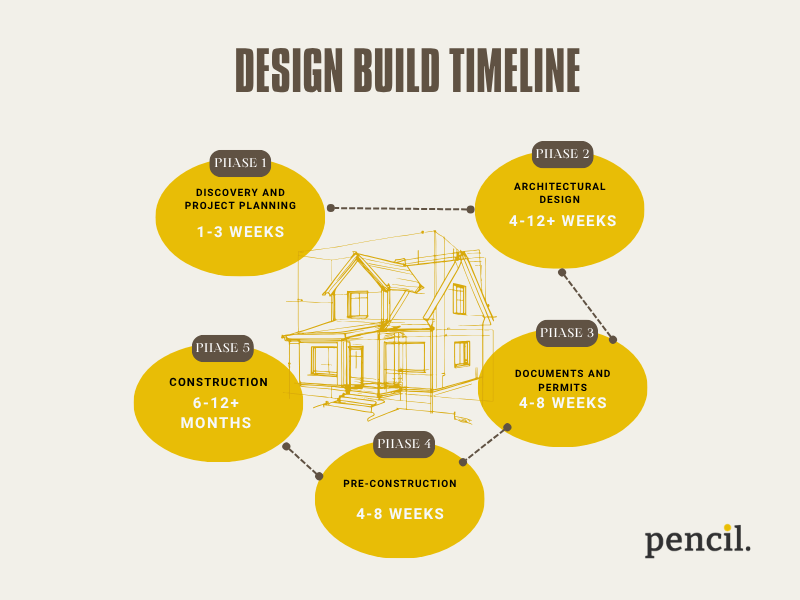
Phase 1: Discovery and Project Planning
Typical duration: 1–3 weeks
Client involvement: HIGH
Before drawings are created, the project needs direction. This is where you and your design-build team establish the foundation for the entire project.
You'll typically discuss:
- Your lifestyle and family needs
- Lot location and conditions
- Desired floor area
- Number of bedrooms
- Budget
- Preferred architectural style
- Target completion date
- Long-term plans for the property
- Priorities and non-negotiables
If you're overseas, this can happen through video calls, online meetings, email, and digital documents.
The goal is to answer one important question: What are we actually trying to build and why?
A good project should not begin with a floor plan. It should begin with understanding the family who will live in it. An architect needs these notes to help you design what you’re trying to imagine.
What the remote client does
The good news is you don't need to be in the Philippines for every conversation. Your main responsibility is to provide clear information and make the major decisions needed to move forward.
Your design-build team should handle the coordination behind those decisions.
Phase 2: Architectural Design
Typical duration: 4-12+ weeks
Client involvement: HIGH
This is where your vision starts becoming a real home.
The design process may include:
- Space planning
- Concept development
- Floor plans
- Exterior design
- Interior planning
- Material direction
- 3D visualizations
- Design development
- Engineering coordination
- Construction documentation
The exact duration depends on the size and complexity of the project. For a custom home, this stage deserves time because decisions made here affect everything that follows.
A poorly resolved design can lead to changes during construction.
A well-coordinated design gives the construction team a clearer path forward.
What the remote client does
This is one of the stages where your involvement matters most.
You may review:
- Floor plans
- 3D views
- Elevations
- Material selections
- Fixtures
- Lighting concepts
- Kitchen and bathroom layouts
You don't need to sit beside the architect. You need a clear way to see the design, understand the options, give feedback, and approve decisions.
Phase 3: Engineering, Construction Documents, and Permits
Typical duration: 4-8+ weeks
Client involvement: LOW
Once the architectural direction is established, the project moves into technical coordination.
Depending on the project, this can involve:
- Structural plans
- Electrical plans
- Plumbing plans
- Mechanical plans
- Sanitary plans
- Architectural construction drawings
- Specifications
- Permit documents
The plans then move through the required permit process.
In Davao City, the OCBO handles building-related permits and occupancy permits. The city's Online Building-Related Permit System also allows applicants to submit documents and monitor the status of applications online.
Permit timelines should always be treated as estimates rather than guaranteed dates because requirements, corrections, evaluations, and project-specific circumstances can affect processing.
What the remote client does
This is usually a lower-touch stage for the homeowner. Your team handles the coordination.
You may simply need to:
- Provide identification and property documents
- Sign required forms
- Clarify ownership information
- Approve certain documents
- Respond when a decision is needed
The objective is to keep the paperwork moving without requiring you to make unnecessary trips home.
Phase 4: Pre-Construction
Typical duration: 2-4 weeks
Client involvement: MODERATE
Before construction begins, the project needs to be organized. This is the stage where the team prepares for actual construction.
Typical activities include:
- Finalizing the construction schedule
- Mobilizing the site
- Confirming construction drawings
- Coordinating subcontractors
- Ordering long-lead materials
- Finalizing initial material selections
- Establishing site safety procedures
- Setting communication protocols
- Confirming payment milestones
- Preparing the site
This stage is particularly important for remote clients. Why? Because once construction begins, you don't want every small decision to become an emergency. The more that can be resolved before mobilization, the smoother the construction phase becomes.
Phase 5: Construction
Typical duration: 6-12+ months
Client involvement: LOW to MODERATE
This is the phase most homeowners think about when they hear "house construction." But construction is not one activity. It is a sequence of coordinated stages.
A typical home may move through:
1. Site preparation – The team prepares the property for construction. This may include clearing, layout, excavation, temporary facilities, and other site works.
2. Foundation – Footings, foundations, and other structural elements are constructed.
3. Structural works – Columns, beams, slabs, stairs, and other major structural components are completed.
4. Roofing and waterproofing – The house begins to become weather-protected.
5. Masonry and partitions – Walls and other partitions are constructed.
6. Electrical and plumbing rough-ins – Utilities are installed before walls and ceilings are closed.
7. Plastering and surface preparation – Walls and ceilings are prepared for finishing.
8. Flooring and tile works – Tiles and other floor finishes are installed.
9. Doors, windows, cabinetry, and carpentry —Major architectural details begin coming together.
10. Painting – Interior and exterior surfaces are finished.
11. Fixtures and equipment – Lighting fixtures, plumbing fixtures, hardware, and other elements are installed.
12. External and landscape works – Driveways, fences, landscaping, and other site improvements are completed where applicable.
13. Testing, inspection, and punch list – The team identifies items that need correction or completion before turnover.
Construction schedules should be documented rather than treated as a vague promise. The Construction Industry Authority of the Philippines notes that contractors should submit a construction schedule after the contract takes effect, with work milestones and planned start and completion dates. It also provides for addressing construction slippage and catch-up schedules when appropriate.
What Are You Actually Doing During Construction?

This is one of the biggest differences between a well-managed project and one that becomes stressful for the homeowner. You should not have to manage construction from your phone. Instead, your involvement can be structured around milestones.
For example:
Weekly or scheduled updates
You receive:
- Site photos
- Construction progress
- Completed activities
- Upcoming activities
- Issues requiring attention
- Decisions required from you
Milestone approvals
Instead of approving hundreds of small tasks, you focus on meaningful decisions.
For example:
"The structural works for the second floor are complete."
"The kitchen cabinet design is ready for approval."
"The selected bathroom fixtures are ready for procurement."
"The house is ready for painting."
This creates a much calmer experience. You're informed without being overwhelmed.
What If Something Goes Wrong While I'm Abroad or Away?
This is where the quality of your project management matters. Construction rarely follows a perfectly straight line.
There may be:
- Weather delays
- Material shortages
- Supplier delays
- Unexpected site conditions
- Design clarifications
- Minor workmanship issues
- Permit-related delays
- Changes requested by the homeowner
The question isn't whether something unexpected will happen.
The better question is:
What happens when it does?
A good design-build process should have a clear system for handling changes.
For example:
1. Identify the issue
The team documents what happened.
2. Explain the impact
You are told what it affects—cost, schedule, design, or all three.
3. Present the options
You understand the available solutions.
4. Get approval when necessary
Major changes shouldn't happen without the homeowner's knowledge and approval.
5. Document the decision
The agreed solution becomes part of the project record. This is especially important when you're not physically present. You don't want to discover three months later that a major decision was made without you.
The Remote Homeowner's Role at Every Stage
Here's the simplest way to think about it:
Your job is to make decisions.
Their job is to manage the process.
That distinction can make all the difference.
How a Design-Build Firm Makes Remote Construction Easier
When the architect and contractor operate as separate parties, homeowners can sometimes find themselves coordinating between different teams.
With design-build, the design and construction functions are brought under one coordinated process.
That can simplify communication.
Instead of asking: "Should I ask my architect or my contractor about this?" you have one team responsible for coordinating the project.
This matters even more when you're abroad.
Your design-build partner can coordinate:
- Design
- Engineering
- Permits
- Construction
- Procurement
- Subcontractors
- Site coordination
- Quality checks
- Project documentation
- Turnover
The homeowner still makes important decisions.
But you don’t have to become your own project manager. At Pencil Design Studio, every project has a dedicated Project Manager who oversees the journey from design to construction—coordinating the team, managing the details, and keeping everything moving forward.

We Will Make Your Home Construction Easier
For many successful Filipino families, the reason they can't be on-site every day is also the reason they're finally ready to build.
A home is one of the biggest investments a family can make. The process should feel intentional from the first conversation to the day you receive the keys.
At Pencil Design Studio, we believe building a home should be a partnership not another job for the homeowner. We guide families through the design and construction journey so they can stay involved in the decisions that matter without having to manage every detail on-site. Because you shouldn't have to choose between building the home you want and living the life you've worked hard to build.
If you're building in Davao City or elsewhere in the Philippines we can help you understand what's possible for your lot, lifestyle, and budget.
Tell us about your vision, and let's start planning your dream home.
Frequently Asked Questions (FAQs)
More Great Resources For You
More Great Resources For You
Let’s build your dream home now, shall we?
We guarantee you that we won’t rest until your dream home has come to life.
